Journal selection / Submission
The Rejection That Happens Before Anyone Reads Your Paper
Why choosing a journal is mostly guesswork, and how to pick one with evidence instead.
You finish the final proofread, pick a journal, and upload the files. Three days later, an email arrives. The editor thanks you for your submission and says the paper is not a good fit for the journal. There are no reviews and no comments, just a decision made in a few minutes.
Most researchers have seen this email at least once. The frustrating part is that the paper was never judged on its quality. It was judged on whether it belonged, and the author guessed wrong.
Why Choosing a Journal Is Mostly Guesswork
Most people pick a journal the same way. They look at where similar papers were published, ask a supervisor, or choose the highest impact factor they think they can reach. Scope statements are vague, and almost every journal describes itself as welcoming high-quality work across a broad range of topics. Reading the aims page tells you very little about what the editors actually accept.
Fit is also about more than topic. Journals have preferences for the type of contribution, the size of the dataset, the depth of the evaluation, and the length of the paper. These are rarely written down. You only learn them by reading dozens of recent issues, which few people have time to do.
Who Loses the Most Time
A wrong choice does not hurt everyone equally. Experienced authors usually know the venues in their area and can redirect a paper quickly. Early career researchers, and anyone working outside a large lab, often have no one to ask. They submit with less information and pay more for each mistake.
The costs build up:
- Each wrong submission can cost weeks, even when the rejection is fast.
- Many journals ask for specific formatting, so every new target means more rework.
- A paper that moves through several journals in turn can go stale, and the related work may need updating each time.
- Some authors aim lower out of fear and publish in a venue that undersells the work.
What Editors Check First
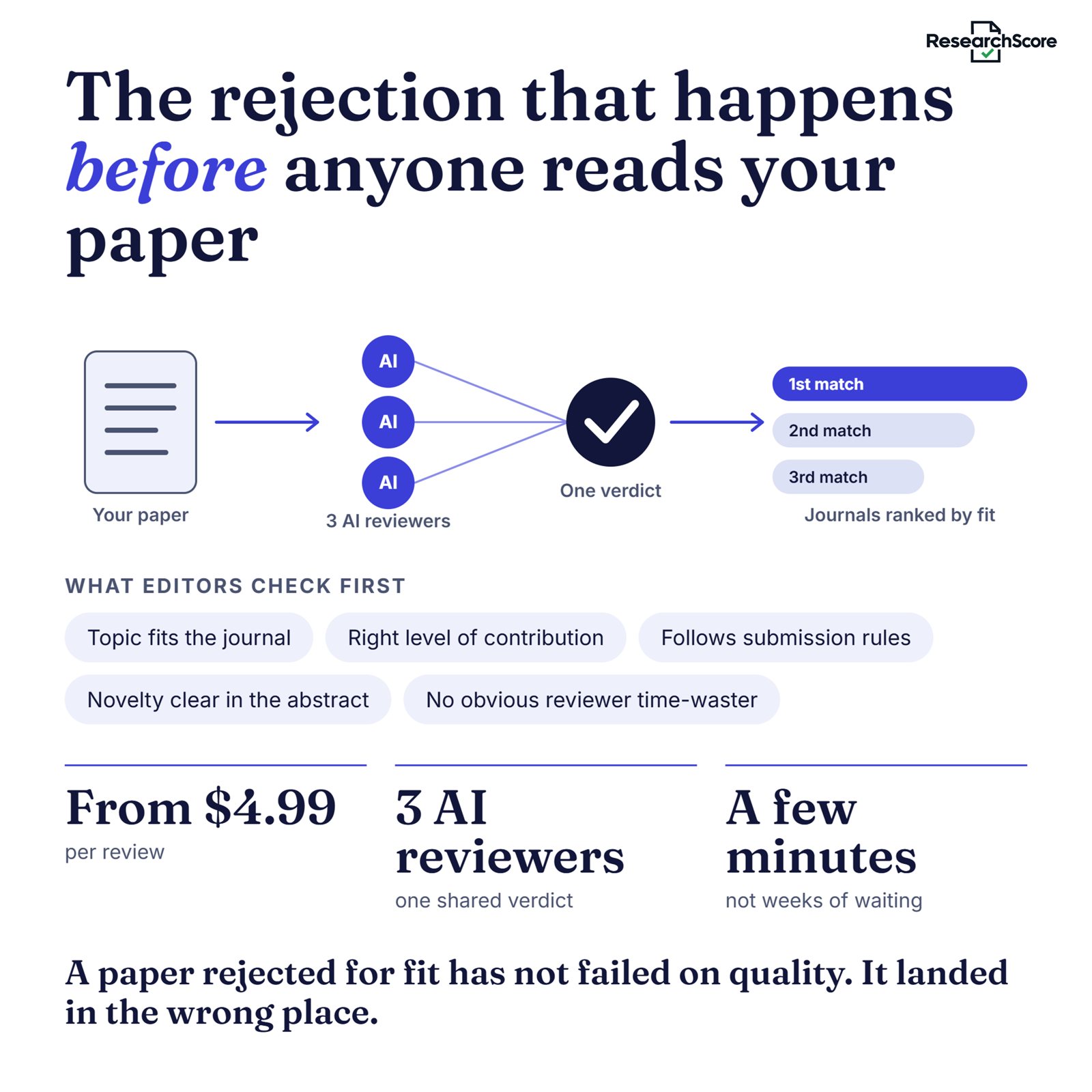
Before a paper goes to reviewers, editors usually ask a short set of questions:
- Does the topic match what the journal publishes?
- Is the contribution at the level the journal expects?
- Does the paper follow the submission requirements?
- Does the abstract make the novelty clear within a few lines?
- Is there any obvious problem that would waste a reviewer's time?
Answering these honestly about your own paper is hard, because you are too close to it. That is where ResearchScore helps.
Finding a Journal That Fits with ResearchScore
Start by uploading your manuscript as a PDF, DOCX, or LaTeX file. The tool extracts the sections, figures, tables, and references, then passes the paper to three separate AI reviewers. Each forms its own view, they compare and challenge each other's conclusions, and the panel settles on one verdict. Along with the scores, you get a list of journals ordered by how closely they match your paper.
These matches are drawn from what your paper actually contains, not from a broad assumption about your discipline, so they are a more grounded place to begin. The report also shows the strong and weak points behind each ranking, which tells you what to improve before you submit to any journal. If a score seems wrong to you, you can ask the reviewer to explain it or request a specific revision.
Reviews begin at $4.99 and finish in a few minutes. Labs and teams can choose a bundle or subscription, and each paid plan comes with an itemized invoice that you can put forward for reimbursement, subject to your institution's policy.
The Takeaway
A paper rejected for fit has not failed on quality. It has simply landed in the wrong place. Choosing your target with evidence, before you submit, is a small step that can save weeks of waiting.