Journal selection / Submission
Your Paper Was Rejected in Two Days. The Editor Never Even Sent It Out.
Why desk rejections happen, and how to check journal fit before you submit.
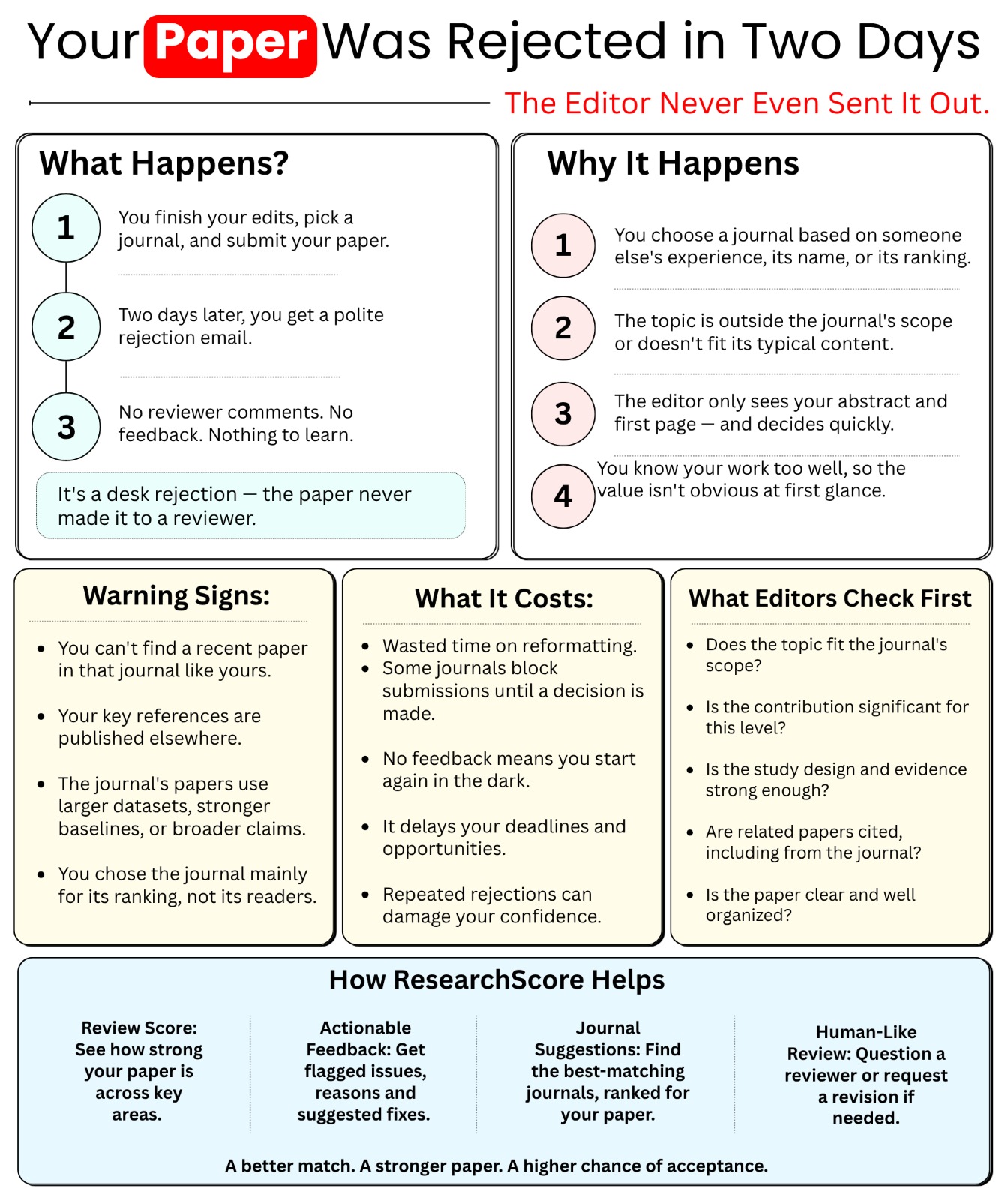
You finish the final round of edits, pick a journal, and upload the files. Two days later an email arrives. It is polite, short, and tells you the paper is not a good fit for the journal. No reviewer comments, no feedback, nothing to learn from.
This is called a desk rejection, and it is one of the most frustrating outcomes in publishing. The work was never judged on its merits. It simply landed on the wrong desk.
Most authors treat it as bad luck. In reality, it is often a problem that could have been spotted before the upload button was ever clicked.
Why It Happens More Than You Think
Choosing a journal often feels like the last small step before submission, so it gets the least attention. Many authors pick a venue because a colleague published there, because the name sounds right, or because it was the first one that came to mind after months of writing.
Editors see this every day. They have a stack of submissions and a few minutes for each. If the topic sits at the edge of the journal's scope, if the paper reads like a different kind of article than the journal publishes, or if the contribution looks too small for the level of the venue, it is declined quickly. Nobody is questioning your research. They are answering one narrow question: does this belong here?
There is another reason it keeps happening. After months with a manuscript, you know exactly why it matters, so you assume the editor will see it too. But an editor only has the abstract, the first page, and a few seconds of patience. If the value of the paper is not obvious from those, it often does not get a second look.
Signs You May Be Aiming at the Wrong Journal
Some warning signs are easy to miss when you are close to the work:
- You cannot find a single recent paper in that journal that looks like yours.
- Your closest references are all published somewhere else.
- The journal's typical papers use much larger datasets, stronger baselines, or broader claims than yours.
- You chose the journal mainly because of its ranking and not because of its readers.
If two or more of these sound familiar, the match is probably weaker than it feels.
What a Wrong Guess Really Costs
Desk rejections are fast, which makes them look harmless. They are not.
- Every wasted submission uses up days of reformatting, since each journal wants its own structure, reference style, and cover letter.
- Some journals do not allow a paper to be submitted elsewhere until a decision is made, so a slow "no" holds the paper back.
- A fast rejection teaches you nothing, so you restart without knowing what was wrong.
- Each round pushes you closer to a thesis deadline, a grant report, or a hiring cycle.
- Several rejections in a row can make you doubt a paper that was never the problem.
Early career researchers and students feel this most. Without a senior co-author who knows the field's venues well, the choice becomes a guess, and a guess can cost months.
What Editors Check First
Before a paper goes anywhere near a reviewer, the editor is usually asking a few simple things:
- Does the topic match what the journal publishes?
- Is the contribution significant enough for this level?
- Is the study design and evidence strong enough to be worth a full review?
- Are the closest related papers cited, including ones from the journal itself?
- Is the paper written and organized clearly enough to send out?
Most authors can answer the first question with a quick look at the journal website. The rest are much harder to judge about your own work.
How ResearchScore Helps
ResearchScore looks at your paper the way an editor and a review panel would, before you submit. You upload a PDF, DOCX, or LaTeX file, and the tool reads the sections, figures, tables, and references. Three independent AI reviewers assess the paper, challenge each other's findings, and settle on one verdict, which is closer to how a real panel works than asking a single chatbot for an opinion.
You receive:
- A score across the main review areas, so you can see how strong the paper is before an editor does.
- Flagged passages with the reason and a suggested fix, so weak spots can be repaired first.
- Journal suggestions ranked by how well they match your paper, which gives you a shortlist instead of a guess.
- The chance to question a reviewer if you disagree with a score, or to ask for a concrete revision.
The two parts work together. The scores show how ready the paper is, and the journal suggestions show where that level of paper is most likely to be taken seriously. A strong paper aimed at the wrong venue and a weak paper aimed at the right one both end up in the same place, and seeing both sides at once helps you decide what to fix and where to send it.
It takes a few minutes, and a single review starts at $4.99. Bundles and subscriptions are available for labs and teams, and paid plans include an itemized invoice you can use for reimbursement, depending on your institution's policy.
The Takeaway
A rejection that arrives in two days is not about how good your research is. Very often it is about fit, and fit can be checked. Spending an hour on the match between your paper and your target journal, along with an honest review of the paper itself, is a small price compared to starting over with nothing learned.