Peer review / Submission
The Mistakes Reviewers Always Catch, and Authors Always Miss
And why checking your own paper before submission is harder than it looks.
You read the abstract one last time, click submit, and feel a small wave of relief. Then the waiting starts.
Two months later, the reviews come back. One reviewer says the main comparison changes two variables at once. Another points out that a closely related paper was never cited. The third finds the conclusion stronger than the results allow. None of this is a surprise once you read it. It is just information you needed before you submitted, not after.
Most researchers know this feeling. The frustrating part is that reviewers are rarely finding anything hidden. They are simply reading the paper with fresh eyes, and by that point the author has none left.
Why You Can't Review Your Own Paper
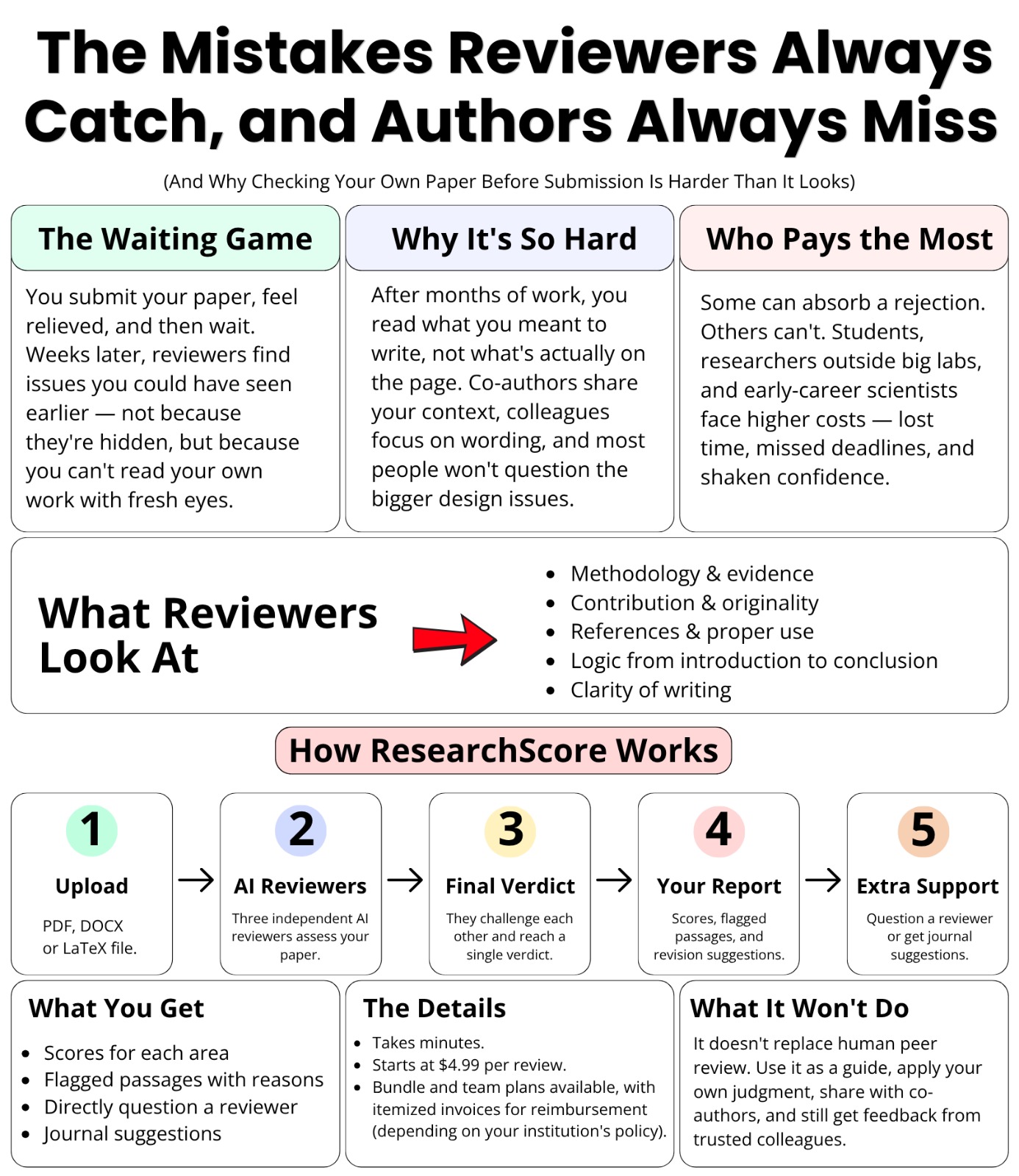
After months with a manuscript, you stop reading what is on the page and start reading what you meant to write. Gaps in the argument feel filled in because you already know the missing steps. Co-authors have the same problem, since they share your context and your assumptions. Friendly colleagues tend to comment on wording instead of the design of the study, and very few people want to say that a core experiment doesn't prove the claim.
There is also a practical issue. Most people have only one or two trusted readers, and each of them brings one perspective and one set of habits. A paper can pass through both and still carry the exact weakness a stranger will spot in the first ten minutes.
Who Pays the Most for a Late Rejection
A rejection does not cost everyone equally. A senior researcher with a long publication record can absorb a bad round and move on. A PhD student who needs one paper to graduate cannot. Researchers working outside large, well-connected labs often have fewer people nearby who can give a critical read, so they go into submission knowing less than their peers do.
The costs add up quickly:
- Months pass between submission and decision, and a rejection restarts that clock.
- Conference and grant deadlines do not move, so a late rejection can mean missing the whole cycle.
- Reviewer comments about methodology can force a redesign of the study, not just a rewrite of the text.
- Repeated rejections wear down confidence, even when the underlying work is solid.
What Reviewers Actually Look At
Whatever the journal, the questions are usually the same:
- Is the methodology sound, and does the evidence support the claims?
- Is the contribution clearly different from the closest existing work?
- Are the key references present and used properly?
- Does the logic hold from the introduction to the conclusion?
- Is the writing clear enough to follow without effort?
Checking all five yourself, honestly, is difficult. That is where ResearchScore comes in.
How ResearchScore Works
ResearchScore gives your paper a full review before you submit. You upload a PDF, DOCX, or LaTeX file, and the tool pulls out the sections, figures, tables, and references. Three independent AI reviewers then assess the paper across those five areas. Once each has given an opinion, they challenge one another's findings and settle on a single verdict, which is closer to how a real review panel works than asking one chatbot for feedback.
What you get back is practical:
- A score for each area, so you can see where the paper is strong and where it is weak.
- Flagged passages, with the reason each one was flagged and a suggestion for what to change.
- The option to question a reviewer directly if you disagree with a score, or ask for a concrete revision.
- Journal suggestions that fit your paper, ranked by how well they match.
The whole process takes minutes, and a single review starts at $4.99. There are also bundle and subscription options for labs and teams, and every paid plan includes an itemized invoice you can submit for reimbursement, depending on your institution's policy.
The Takeaway
Most rejections come from problems that were fixable, if only someone had spotted them sooner. A structured review before submission is one of the simplest ways to make sure the first serious critique of your paper arrives while you can still do something about it.