Methods / Reproducibility / Submission
Your Methods Section Makes Sense to You, and That Is the Problem
And why reviewers keep asking "How exactly did you do this?"
You have run the experiments so many times that the methods section feels like the easy part. You write a few tidy paragraphs: the model, the dataset, the training setup, the evaluation. It reads fine. It is accurate. You move on to the parts that feel more important.
Then the reviews come back. One reviewer asks how the data was split. Another wants to know which hyperparameters were tuned and on what. A third says the results cannot be checked because key steps are not described. Nobody says the work is wrong. They say they cannot tell whether it is right.
This is one of the most common reasons a paper gets a major revision, and it is very easy to fix before you submit. The issue is rarely carelessness. It is that the person who wrote the methods already knows everything, so the page never needed to hold it all.
How the Gaps Appear
Missing detail almost never looks like a missing section. It hides inside sentences that seem complete:
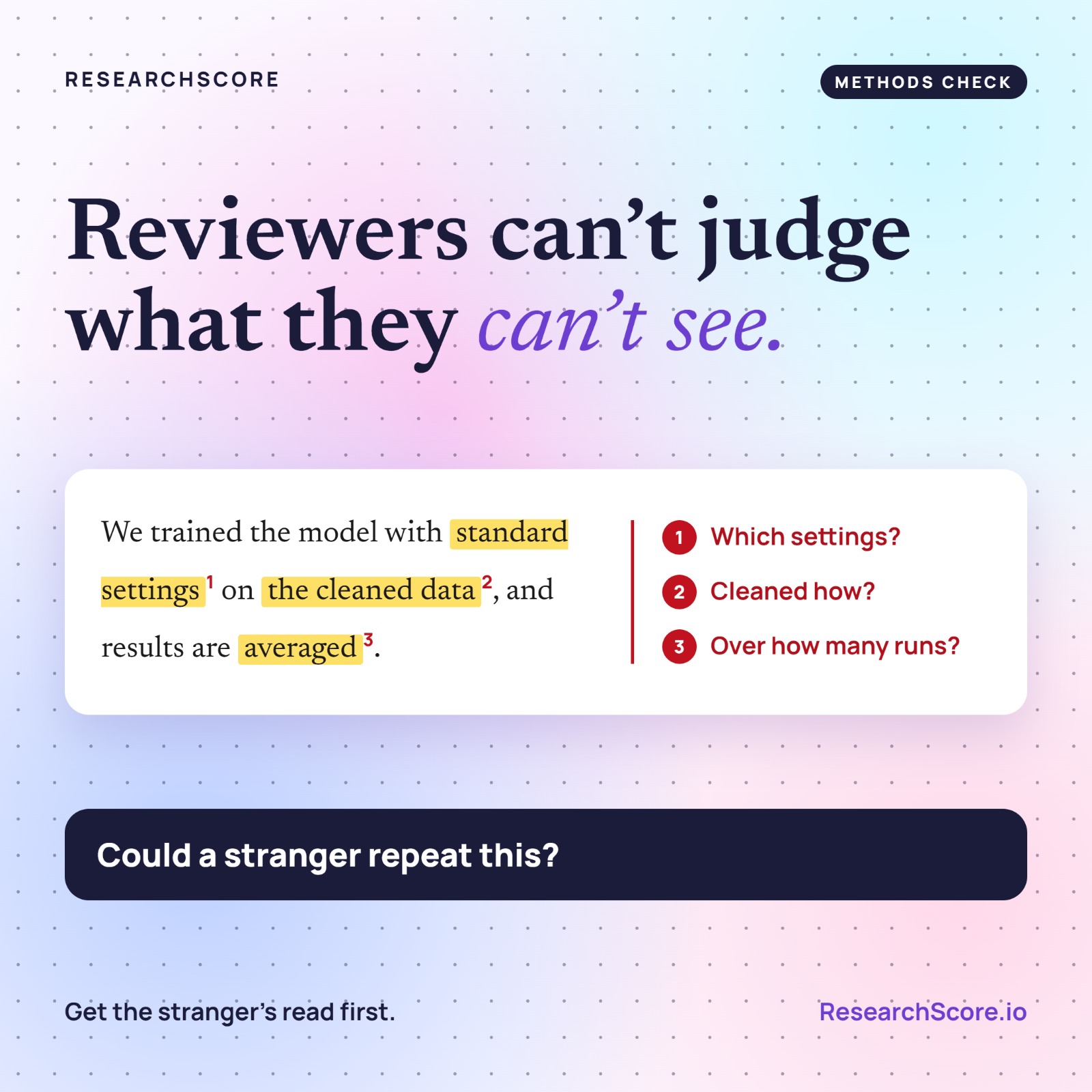
- "We trained the model with standard settings" and no settings are listed.
- The preprocessing steps live in your code but not in the paper.
- The train, validation, and test split is mentioned but not how it was made.
- Results are reported without saying how many runs they were averaged over.
- Baselines are named, but not how they were set up or tuned.
- A choice made late in the project, like dropping some samples, never makes it into the text.
Each one feels too small to mention. Together, they make the work impossible to repeat.
Why You Can’t See It Yourself
You were there for every decision. When you read "we cleaned the data," your mind fills in exactly how, because you did it. The sentence is a shortcut to a memory, and the reader does not have that memory.
Coauthors have the same problem, since they sat through the same meetings. Friendly readers usually focus on whether the paper is clear, and a paper can feel perfectly clear while still leaving out what someone would need to rebuild it.
What It Costs You
The cost is higher than most authors expect:
- Reviewers cannot judge what they cannot see, so doubt tends to land on the results.
- A vague methods section can turn a small revision into a major one.
- You may be asked for extra details or new runs, often with a short deadline.
- Each round adds weeks, and months can pass between submission and decision.
- Readers who try to build on your work give up, and your paper gets cited less.
The painful part is that the experiments were usually fine. The description of them was not.
Who Feels This the Most
An experienced author has been burned by this before and knows what reviewers ask for. A first time author, or a student working without a nearby group to test the draft on, often has not. The results are strong, the deadline is close, and nobody has asked the one question that matters: could a stranger repeat this?
One outside read before submission helps that person the most.
What a Careful Check Looks Like
Read your methods section as if you were a stranger with the same data and no access to your code. Then ask:
- Could I rerun this and expect similar numbers?
- Is every choice that affects the result written down, including the awkward ones?
- Does the paper say what was tuned, on which data, and what was left alone?
If the answer to any of these is "no," that part needs more detail.
A Simple Way to Close the Gaps
- List every step from raw data to final number, in order.
- Next to each step, point to the sentence in the paper that describes it.
- Mark any step with no matching sentence, or only a vague one.
- Add the missing settings, sizes, versions, and counts.
- Move long details to an appendix if needed, but say where to find them.
- Ask someone outside the project to read only the methods and tell you what they would do differently.
This takes an afternoon, and it is much shorter than a rebuttal letter.
Where ResearchScore Helps
ResearchScore gives you the stranger’s read before a real one does. Upload your manuscript as a PDF, DOCX, or LaTeX file, and it breaks the paper into its parts: sections, figures, tables, and references. Three separate AI reviewers then go through it, scoring five areas that include how well the methods are described and whether the results back up what you say. They do not stop at their own opinions. The reviewers question each other’s findings and agree on a final verdict, much like a small review panel would, instead of the single answer you get from one chatbot.
Here is what you get back:
- A score for each area, so you know which parts of the paper are solid and which need work.
- Highlighted passages, each with the reason it was flagged and a suggested fix, such as a missing setting or an unclear step.
- A way to push back on any reviewer if you disagree, or to ask for a specific rewrite.
- A ranked list of journals that fit your paper.
A review takes minutes and starts at $4.99. Labs and teams can choose bundles or subscriptions, and every paid plan comes with an itemized invoice you can use for reimbursement, depending on your institution’s policy.
The Takeaway
Most hard reviews do not come from bad research. They come from a gap between what you did and what the page lets a reader see. Closing that gap before you submit is one of the quickest ways to make sure the first serious question about your methods is one you have already answered.