Figures and tables / Submission
Your Figures and Tables Are Telling a Different Story Than Your Text
And why reviewers often read them first.
You spend weeks on the writing, and the figures get finished at the end. A quick plot from the notebook, a table pasted in from a spreadsheet, a caption written in two minutes. The text explains everything, so the visuals only need to sit there and agree with it.
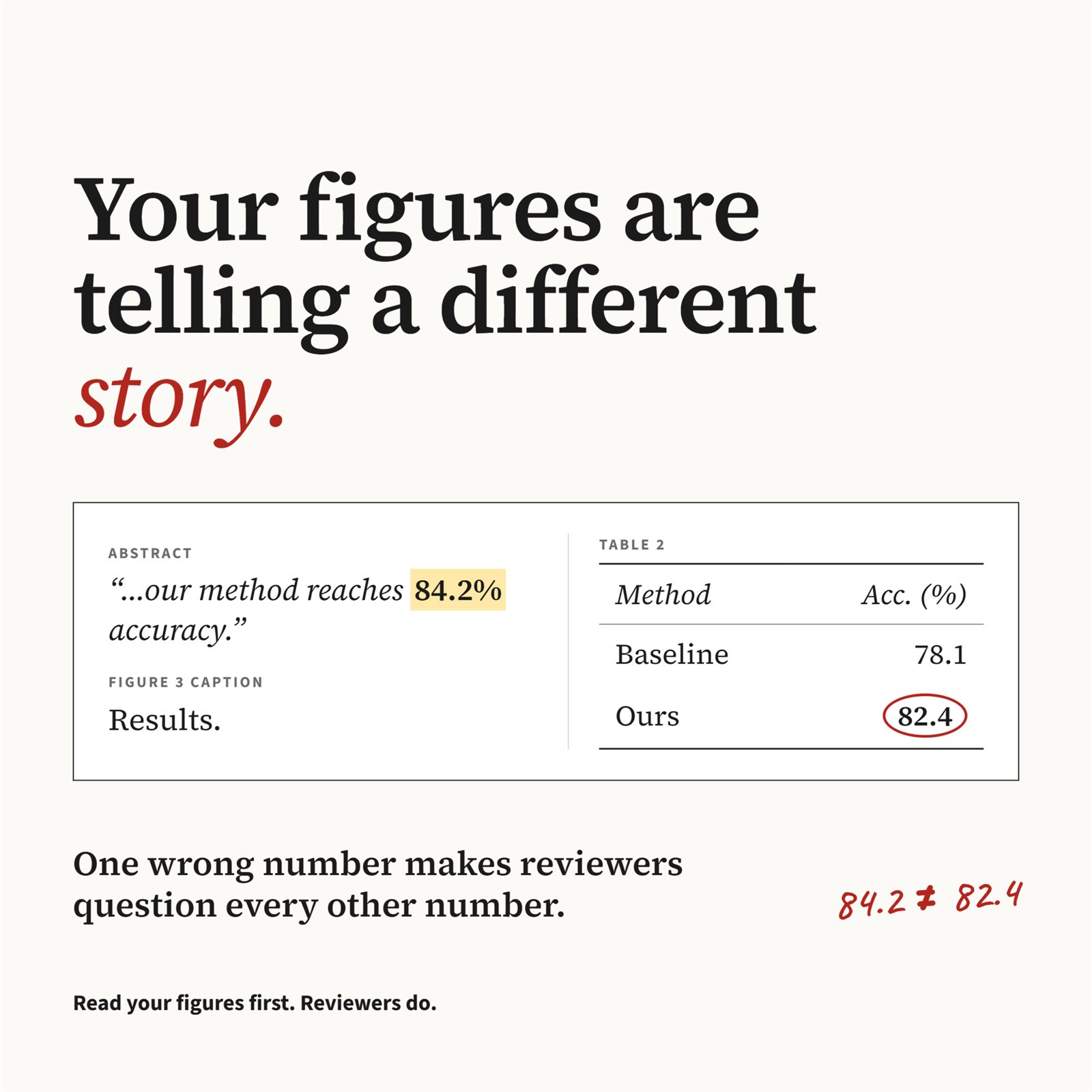
Then the reviews arrive. One reviewer says Figure 3 is impossible to read without searching the text. Another points out that the numbers in Table 2 do not match the ones in the abstract. A third asks what the error bars represent. The writing was careful. The figures were treated as decoration.
This is a very common reason for a rough first review, and it is one of the easiest things to fix before you submit. Many reviewers and editors look at the figures and tables before they read a single paragraph. If those do not stand on their own, the paper starts with a handicap.
How the Mismatch Happens
It rarely comes from one big mistake. It builds through small edits made at different times:
- A table is updated after a rerun, but the sentence quoting it is not.
- A figure keeps an old label after a method was renamed.
- Captions describe what was plotted, not what the reader should notice.
- Axes, units, or error bars are left unexplained.
- Two figures use different colors for the same method.
- A reference list and the in-text citations slowly stop matching.
Each one looks like a typo. A reviewer sees a paper that is not quite under control.
Why You Cannot Spot It Yourself
You know what every plot is meant to show, so you read the intention and not the image. A cluttered legend looks fine because you already know which line is which. A table with no units looks fine because you remember the units.
Coauthors have the same blind spot, and most readers will not go through every number to check that the abstract, the text, and the tables agree. That checking is slow, dull work, and it is exactly the work a reviewer will do when they are looking for reasons to doubt.
What It Costs You
The price is larger than a few lines of corrections:
- A single wrong number makes reviewers question every other number.
- Unclear figures lead to misreadings, and misreadings lead to unfair criticism.
- You may be asked to redo plots and recheck results on a short deadline.
- Each round of corrections adds weeks to a process that is already slow.
- Small errors can make a strong paper look rushed.
The frustrating part is that the results were usually correct. The presentation made them look doubtful.
Who Feels This the Most
If you are writing alone, or with coauthors who are all working in different places, nobody may ever read the paper start to finish with fresh eyes before submission. The deadline is close, the final edits are rushed, and the details that need the most care get the least.
A careful outside read at that stage matters more than most authors expect.
What a Careful Check Looks Like
Go through the paper in a different order. Look only at the figures and tables first, then ask:
- Can I understand each one from the caption alone?
- Does every number in the text match the number in the table or plot?
- Is each term, label, and color used the same way throughout?
If the answer to any of these is "no," that item needs another pass.
A Simple Way to Tighten Things Up
- List every figure and table, with the claim each one is meant to support.
- Read each caption on its own and rewrite any that need the text to make sense.
- Check every number quoted in the text against its source table or plot.
- Make labels, units, abbreviations, and colors consistent across the paper.
- Confirm that every in-text citation appears in the reference list, and the other way around.
- Hand the figures alone to someone outside the project and ask what they think each one shows.
This takes an afternoon, and it can save a lot of back and forth later.
Where ResearchScore Helps
ResearchScore reads your manuscript the way a reviewer would, including the parts that are easy to overlook. Upload a PDF, DOCX, or LaTeX file, and the tool separates out the sections, figures, tables, and references so each can be examined on its own terms. Three independent AI reviewers then evaluate the paper across five areas, such as the soundness of the methods and how well the evidence supports the claims. Rather than stopping at three opinions, they debate their findings and land on one combined verdict.
You receive:
- Scores for each area, showing where the paper stands out and where it falls short.
- Marked passages with the reason for each flag and a suggested improvement.
- The chance to ask a reviewer why it scored something the way it did, or request a specific rewrite.
- A ranked list of journals that suit your manuscript.
Reviews are quick, and one starts at $4.99. Labs and teams can use bundles or subscriptions, and paid plans include an itemized invoice that you may be able to submit for reimbursement, depending on your institution.
The Takeaway
Most hard reviews do not come from bad research. They come from small gaps between what the text says and what the figures and tables show. Closing those gaps before you submit is a simple way to make sure the first serious question about your results is one you have already answered.